

Learn to create accurate personas to enhance marketing, sales, and digital business planning strategies.
In the business world, building strong bridges with your audience is the difference between staying relevant and being just another brand in the market. One of these essential bridges is the concept of a persona. When well-mapped and utilized, it can not only transform marketing strategies but also redefine products, services, and even the business's positioning.
The point is simple: a persona is not 'a pretty document'. It's a practical tool for making better decisions — with less waste, more empathy, and greater consistency.
What exactly is a persona, and why does it go beyond a target audience?
Before moving on, it's worth clarifying. Many people still confuse personas with target audiences. Both are related concepts, but they differ in depth and function.
A target audience is usually a broad definition, a demographic and behavioral segment, such as: 'women aged 25 to 40, living in capital cities, with medium to high income, interested in fitness fashion'. It's useful, but something is missing.
A persona, on the other hand, dives into the details. It gains a name, a story, desires, fears, routines, goals, challenges, and even the type of language the person uses when explaining a problem. It represents the ideal customer as if they were a real character — with human nuances, not just data.
A persona is not cold data, but a living story.
If the target audience describes 'who buys', the persona explains 'why they buy' and 'how they decide to buy'.
Target audience: statistical group
Persona: individual character (almost palpable)
It might seem like a minor detail, but this is where the difference lies between communication that resonates and communication that goes unnoticed.
How personas simplify and enhance strategies
Have you noticed how generic campaigns often sound empty? It's easy to feel that 'something is missing'. When we talk about marketing, content, ads, sales, and even product development, knowing exactly who you're talking to changes everything.
More mature brands use personas to:
Create well-targeted messages
Choose more appropriate channels
Prioritize product features according to real needs
Improve customer experience (including post-sales)
Reduce resource waste with actions designed for 'everyone'
In other words: a persona doesn't serve to 'explain the customer'. It serves to guide decisions.
Personas in digital marketing, planning, and communication
Think of brands that have made an impression on you as a consumer. Whether it's an innovative startup or that neighborhood coffee shop where you feel at home, there's something in common: they seem to see you beyond numbers.
Mapping personas deepens business empathy and makes every gesture, post, ad, or interaction more human. This is reflected in all touchpoints:
More fluid and authentic communication
Tailor-made content
More accurate campaign planning
Products that positively surprise
Less friction in service and sales
Talking to real people, in a real way. That's how you build relevance.
Furthermore, teams aligned around this profile advance with greater synergy — from marketing to customer service, from sales to product. Each area feels that their actions have a clear 'why'.
Practical construction: a step-by-step guide to creating your persona
Now, let's get to the more tangible part. Creating a personalized profile might require some dedication, but it's not rocket science.
Here's a reliable roadmap for designing your personas in a practical way — without magic formulas or guesswork:
1. Gather real data and information
The first step is to listen before creating. Collect information from all available sources: surveys, customer databases, online forms, support reports, website metrics, feedback received on social media.
What to observe:
Age group and context (not just 'age')
Occupation, education, and level of autonomy in decision-making
Routine and purchasing habits
Most frequent pain points, questions, and complaints
Motivations for choosing (or rejecting) solutions
This base material is the foundation of the construction.
2. Conduct qualitative interviews
In-depth conversations help you see beyond the numbers. Contact current customers, former customers, and even cold leads. An open chat provides information that spreadsheets never show: emotions, expectations, frustrations, and real language.
Useful questions:
How did you find our company?
What challenges do you face in your daily life?
What do you like most (or least) about solutions similar to ours?
How do you make purchasing decisions?
What would make you say 'yes' with confidence?
Honest tip: don't just interview happy customers. Dissatisfied ones also have a lot to teach.
3. Analyze data and look for patterns
With a reasonable volume of information, try to identify patterns and recurrences. There are always groups of people with similar pain points or desires. Let the data show you the way, even if it surprises you.
4. Build the persona profile
Now, it's time to bring the character to life. Create a 'profile card' with what truly influences decisions:
Fictional name (helps humanize)
Age (as a reference, not a label)
Profession/occupation and work context
Location and market scenario
Short Bio (story + current situation)
Goals & Challenges (goals and challenges in a list format)
How they use the product/service (what they seek and why)
The closer to reality, the better. Avoid caricatures: there's no perfect customer — much less one that's too perfect.
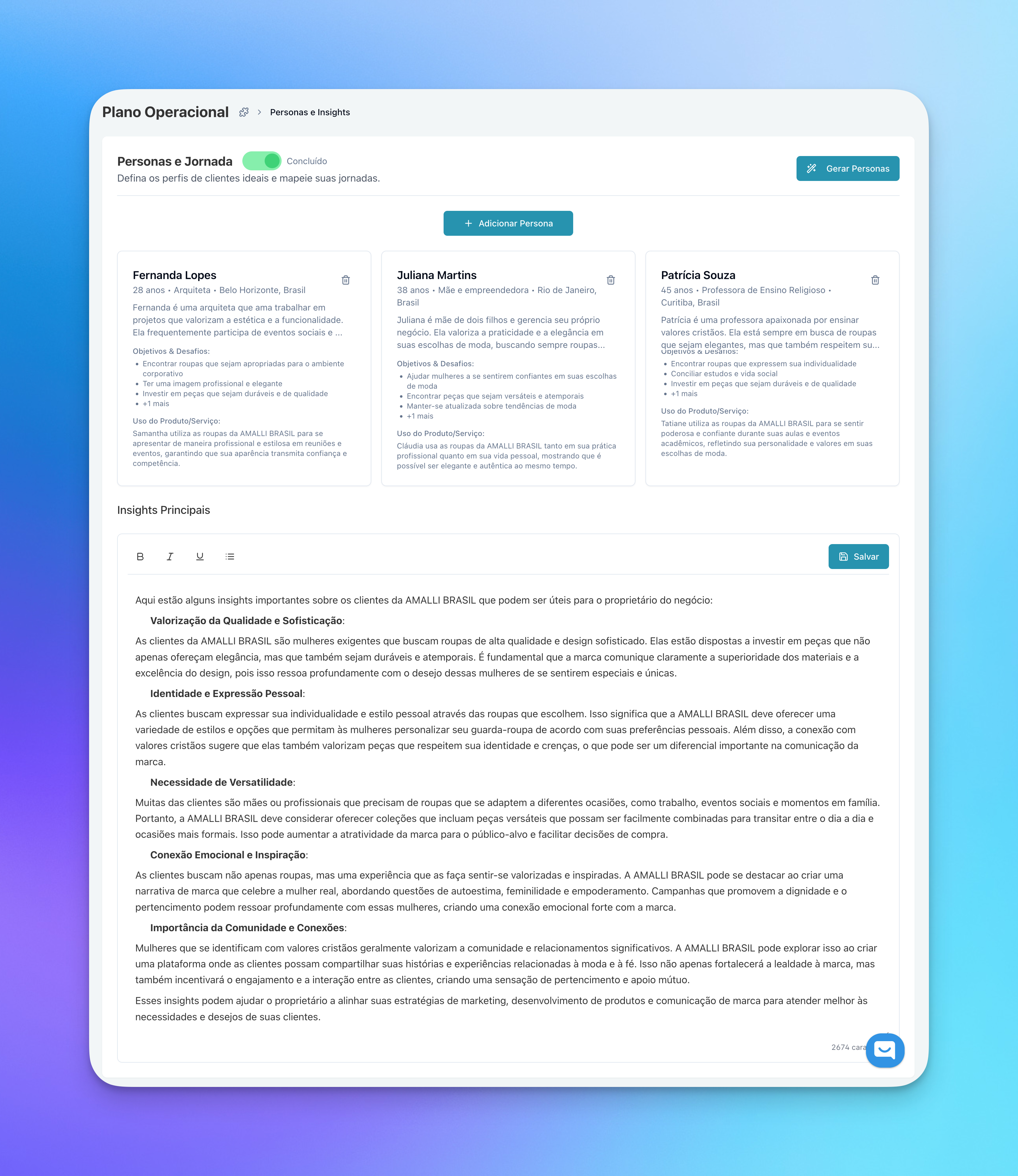
How this appears in practice in Vibz: you can keep multiple personas in card format, facilitating comparison and quick reading. Clicking to create or edit opens a drawer with objective fields (name, age, occupation, location, bio) and an editable list of Goals & Challenges — item by item — in addition to the Product/Service Usage field, to record exactly how that persona relates to the solution.
And there's a powerful detail: Vibz allows you to generate personas with AI as a starting point (to gain speed) and, at the same time, edit everything manually (to gain precision). It's the combination that makes sense: AI suggests, you validate.
5. Share and update with the team
For the profile not to become a forgotten file, involve all departments. Present findings, collect feedback, and encourage constant adjustments.
Personas are not static. They grow, change, and surprise. If the market changes, the profile needs to change with it.
Real examples for inspiration
To better illustrate, here are scenarios from different segments. This makes it easier to visualize:

1) Technology company (SaaS for small businesses)
Name: Helena Lopes
Age: 34 years old
Profession: Small e-commerce owner
Context: Limited time, seeks simplification
Pain points: Lack of clarity in financial data
Goal: Organize processes and grow with control
Information sources: Online blogs and forums

2) Vegan restaurant (young, urban, and trendy audience)
Name: Felipe Ramos
Age: 27 years old
Profession: Freelance designer
Context: Busy life and strong values
Pain points: Few quick and affordable options
Goal: Eat well without compromising principles
Information sources: Instagram, podcasts, and friends

3) Dental clinic (family-oriented and traditional audience)
Name: Maria Silva
Age: 46 years old
Profession: Teacher
Context: Values attention and predictability
Pain points: Fear of procedures and high costs
Goal: Take care of the family without financial surprises
Information sources: Relatives' recommendations and WhatsApp groups
Direct link to the buyer's journey and segmentation
Having a clear profile helps to fit each stage of the buyer's journey like a well-oiled machine. After all, each phase — from problem recognition to the final decision — requires different stimuli.
Discovery: the customer understands they have a pain point
Consideration: seeks alternatives and compares options
Decision: chooses a solution (or postpones the purchase)
Mapping personas allows you to create messages, formats, and content suitable for each stage. Direct example: if your persona hardly spends time on Instagram, insisting on 'more Reels' might look good... and be useless. The persona protects you from this kind of waste.
Digital tools, AI, and collaboration in persona creation
It's true: drawing individual profiles by hand takes work. But the advancement of artificial intelligence has taken this process to a new level — with more speed and less rework.
Digital tools can help to:
Organize research and records
Cross-reference data and suggest patterns
Generate profile hypotheses for you to validate
Keep everything updated and accessible to the team
In Vibz, for example, this routine becomes operational: you can generate a persona by AI, keep personas organized in cards, and quickly edit them in the drawer, adjusting goals, challenges, and product/service usage as you learn more about the audience.
Personalization, real data, and avoiding stereotypes
Some errors are common at the beginning:
Designing an idealized character, without a real basis
Focusing on the 'perfect customer' and ignoring real pain points
Repeating stereotypes and generalizations
Ignoring regional, cultural, or market context
The secret is simple: listen to real customers, validate assumptions, and always be ready to adapt the profile when reality shows another path.
A real persona is never just a pretty drawing. It pulses and breathes with time.
Types of personas: which to serve, when, and why?
The concept has evolved and gained different versions, each with a defined role:
Buyer Persona: profile of the ideal buyer (sales and marketing)
Audience Persona: who consumes content and interacts, even without buying
Proto Persona: initial hypothesis profile, great for quick tests
Brand Persona: personification of the brand (tone, voice, attitude)
In maturing projects, it often makes sense to start with a proto persona — and refine it as data and validations arrive.
Integrating personas into the company's daily life
What's the point of all this effort if, in the end, the profile just becomes a pretty slide? The strength of this method appears when it becomes practice.
Simple tips to put the persona at the center of decisions:
Guide campaign and product briefings
Determine language and customer service scripts
Create tailor-made educational content
Adjust offers according to new demands
Train the team with real stories (cases and conversations)
Errors and adjustments are part of it. And that's not a problem: it's a sign of maturity.
Common mistakes when mapping and applying personas
Even experienced professionals stumble into some traps:
Confusing quantity with quality: creating many personas and using none
Building narratives based on guesswork: without data and without interviews
Not involving strategic areas: marketing, sales, product, and customer service need to participate
Stagnating: keeping the profile frozen while the market changes
Excessive irrelevant details: too much information that doesn't change decisions
Less glamour, more truth.
Success indicators: how to know if your persona is well-defined?
It's not always obvious whether the profile has yielded results. Some signs indicate you're on the right track:
Campaigns with greater engagement and more positive responses
Faster customer service with less friction
Feedback that reveals identification with the brand
Consistently growing conversion rates
A more aligned and confident team in decisions
If your actions finally 'speak' to the audience and they respond naturally, smile: your persona is fulfilling its role.
Conclusion
Profiling the audience is not a fad. It's a constant refinement, a careful look at real human beings. Data, when combined with sensitivity and the right tools, reveals opportunities where there were once only uncertainties.
By bringing this approach to the center of planning, you multiply the chances of delivering better solutions, creating consistent relationships, and building a brand that endures — even in a constantly changing market.
Frequently asked questions about personas in business
What is a business persona?
A persona is a semi-fictional representation of the ideal customer. It gathers demographic and behavioral characteristics, pain points, goals, habits, and motivations based on real data (not guesswork). The goal is to humanize the target of strategies and guide decisions in marketing, sales, customer service, and product.
How to create an effective persona?
Start by gathering real data (customer base, surveys, support, and metrics). Conduct qualitative interviews, identify patterns, and build a profile with information that influences decisions. Validate with the team and review periodically. AI resources can accelerate the first version, but quality comes from validation with reality.
Why is mapping personas important?
Because it directs efforts and resources to those who truly matter. It helps reduce waste, improve customer experience, increase conversion, and avoid the trap of talking to 'everyone' — which usually means engaging no one.
How many personas should my business have?
Start with one or two main ones. If you serve very different audiences, you can create secondary profiles. Too many personas can hinder execution, so prioritize the most strategic ones: those that represent the largest volume, highest value, or greatest potential.
How to use personas in my strategy?
Use personas to guide communication, content, campaigns, sales and service scripts, and product decisions. The secret is to keep the profile visible, practical, and updated — integrated into the team's daily life.

Escrito por
Michel Torres
Compartilha aprendizados práticos sobre planejamento, validação e crescimento de novos negócios.
Ver mais artigosPronto para transformar
sua ideia em plano?
O Vibz te guia do esboço ao pitch validado, com dados de mercado, projeções financeiras e uma narrativa pronta para apresentar.
✓ Sem cartão de crédito ✓ Configure em 2 minutos