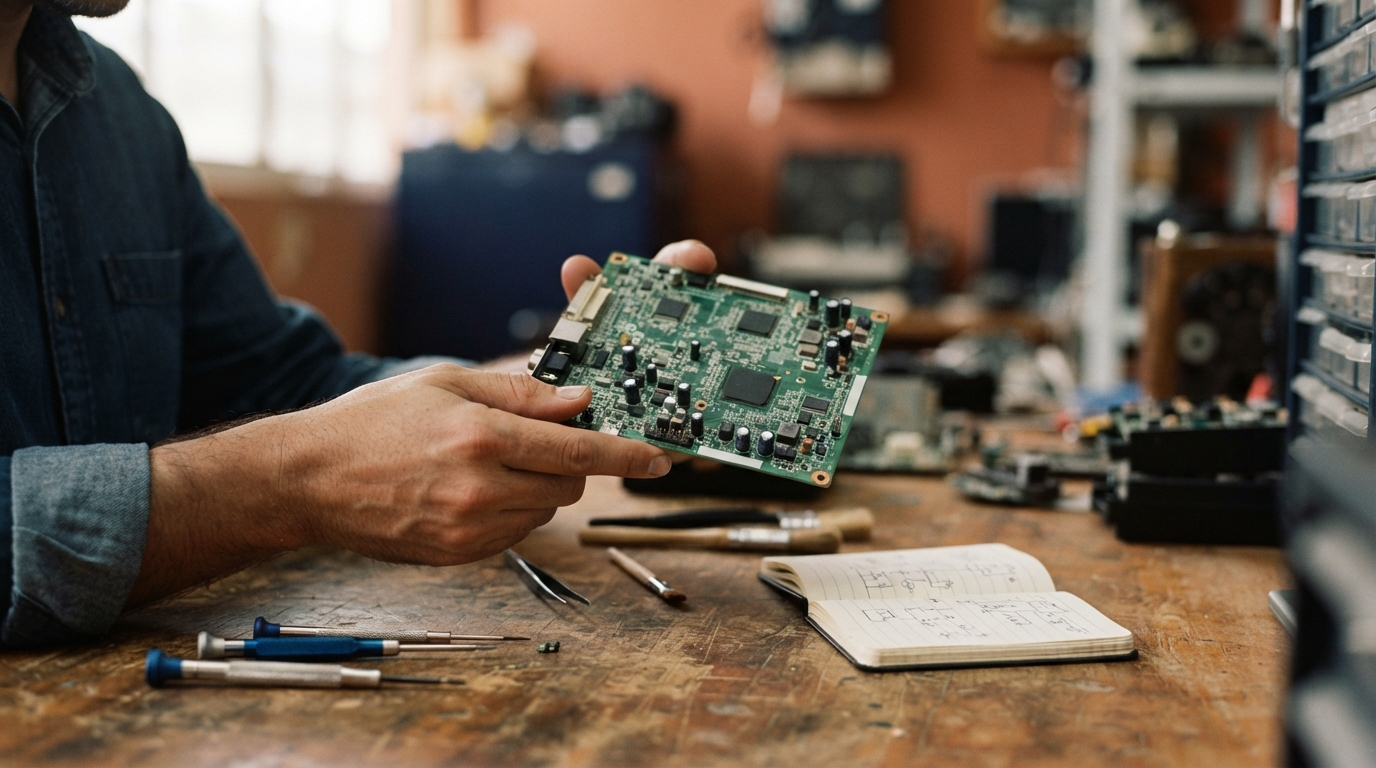
A computer repair shop runs on technical decisions that affect margin from the very first customer. If you work with laptops, desktops, peripherals, or networks, each line changes the kind of parts you need, the time required for diagnosis, the rework rate, and the way the customer sees value.
Before opening, you need to know whether you want to work with high-volume small repairs, more complex services, or corporate support. Each model requires a different setup for bench work, inventory, testing, and warranty, and that defines both the investment and the pace of cash flow.
- technical diagnosis
- parts inventory
- bench time
- service warranty
What you need to understand before moving forward
Which devices will you service?
Laptops, desktops, printers, peripherals, and networks do not have the same complexity or the same need for parts. You need to choose your focus before investing, because it changes the bench setup, tools, turnaround time, and the type of customer that makes sense for your business.
Will your model be repair, upgrade, or recurring support?
One-off repairs, part replacements, preventive maintenance, and support contracts require different routines. When you mix everything without a clear rule, you lose control of the queue, pricing, and service priority.
Which services can you diagnose with confidence?
Not every problem is worth taking on. What you need to map is which failures you can identify consistently, which require longer testing, and which call for a partner or a refusal, so diagnosis does not turn into rework.
Which parts and supplies need to be in stock?
The decision is not to keep a large inventory, but to hold what moves often and avoids unnecessary delays. If you buy too many parts, you tie up capital; if you buy too few, you extend lead times and lose business to faster competitors.
How will you offer warranty without hurting margin?
Warranty in a repair shop needs to be clear by service type and by replaced part. You should define what is covered, for how long, and under which conditions, because that affects return risk, customer trust, and after-sales cost.
Will your service be local, pickup-based, or remote?
The service format changes the whole operation. Pickup and delivery require logistics, remote service needs a triage and support process, and a physical store has to turn walk-ins into approved estimates.
The critical points of this business
Market
You need to understand whether your area generates enough demand for personal device maintenance, small office equipment, or business support. The customer profile defines urgency, ticket size, repeat business, and tolerance for turnaround time.
Offer
Your offer needs to be clearly defined. A repair shop that is too broad usually becomes a messy operation, because each service type requires different tools, knowledge, and parts; a more focused offer makes pricing and delivery promises easier.
Operations
The bench is the center of the business. You need to validate the flow of intake, triage, diagnosis, approval, repair, testing, and return, as well as organize password handling, labeling, parts control, and customer communication.
Finance
Money comes in at different moments depending on the type of service. Some diagnoses turn into repairs, some repairs turn into part replacements, and some customers never approve the estimate; that is why you need cash flow projections that consider estimate conversion, payment timing, and capital tied up in parts.
Location
For a physical store, the location needs to balance access, visibility, and ease of pickup, but it should not depend only on street traffic. In a repair business, trust and convenience matter more than appearance, and that changes how you evaluate the point of sale.
People
The business depends on labor that can diagnose methodically and communicate technical limits without promising what it cannot deliver. If the operation grows, quality drops fast when customer service, the technician, and estimate approval do not follow the same standard.
What can compromise the business
Taking on every kind of device without criteria increases rework and slows the queue. The risk appears when you try to fix what you do not know well, without the right parts or proper testing tools.
Working without a diagnosis process leads to inaccurate estimates and friction with customers. If you do not record intake, reported issue, tests performed, and authorization, it becomes hard to justify timing, pricing, and warranty.
Buying parts before validating demand ties up money in slow-moving items. In a repair shop, inventory should follow what truly moves, not what seems useful in theory.
Promising turnaround time without considering estimate approval and part arrival puts delivery at risk. The problem is not only technical, it is about flow: each stage needs a planned time and clear communication with the customer.
Mixing home users with corporate support without separating routine and pricing creates operational confusion. Companies expect records, recurring service, and more predictable response times; end customers usually decide faster, but they compare value differently.
Turn these questions into decisions
Understanding your market and organizing the plan before opening keeps you from buying infrastructure for a business that has not been defined yet. In Vibz, you turn these decisions into a practical analysis, separating what still needs validation from what can already become an operation.
Business Scope
Use this step to define precisely which services the shop will offer, which problem it solves, and which audience makes sense to serve. This helps close the business thesis before you buy a bench, tools, and parts.
Market Intelligence
Here you organize your reading of the surrounding area, customer profile, and local or regional competition. This is what supports decisions about focus, positioning, and service format, without relying on a vague impression of demand.
Operational Plan
This step helps you design the flow of intake, diagnosis, repair, testing, delivery, and warranty. It is useful for deciding structure, suppliers, team, and channels before the first hire or major purchase.
Financial Modeling
Use this step to turn the chosen model into investment, costs, revenue, working capital, and projected cash flow. In a repair shop, this is what shows whether the service mix and the pace of estimate approval make sense to sustain the operation.
Before investing, you should know
- Which services will you turn away at the door?
- How many weekly customers does your model need to convert into paid work?
- Which parts will you keep in stock and which will you buy on demand?
- How much bench time does each type of repair consume on average?
- What will your rule be for charged, credited, or free diagnosis?
- What warranty can you assume by service type without creating room for conflict?
- Will your service depend more on a physical store, scheduled pickup, or remote support?
Sua ideia merece mais do que um palpite. Estruture o negócio, teste suas premissas e entenda se ele faz sentido antes de comprometer tempo e dinheiro.
Planejar meu negócio no Vibz